
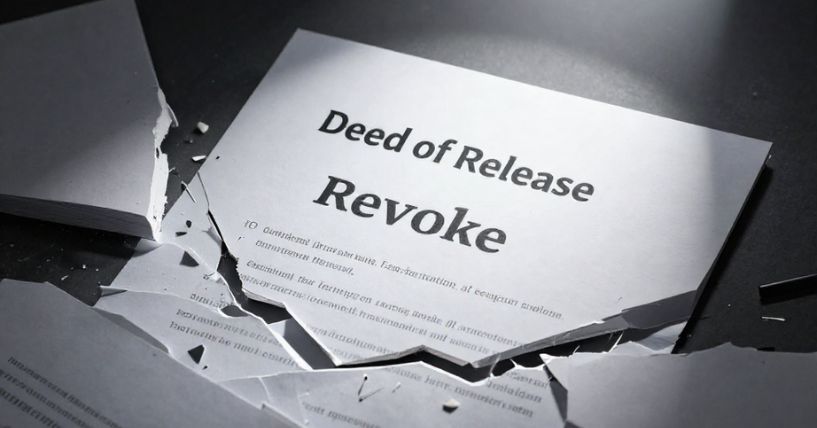
A deed of release is a legally binding document that formally records the end of a dispute or legal obligations. According to the deed of release lawyers Perth, the document releases both parties from future claims or contesting for their rights.
Since it has a binding effect where all parties must give up their legal claim, revoking a deed of release mistakes is often difficult. In this blog, we will discuss the nature of a deed of release and the grounds upon which it can be challenged.
Every individual or citizen residing in Australia has a legal right. They can range from what a person is entitled to, the power to commence court proceedings for a dispute and sue for negligence. So, when the deed of release is made between both parties involved in the dispute, it consists of the following factors:
A deed of release expressively defines the claims upon which the parties contested in court. The reason behind that action is stated along with the liabilities involved of both parties. Then the rights that will be relinquished will be stated clearly. This often includes the present and future rights, so that further court proceedings on the same claim are not enforceable.
The deed of release comes into effect immediately after it is executed. Under the Property Law Act 1969 (WA), even if no money or benefit is exchanged between the two parties, the law recognises the legal status of the deed. Once executed, this legal document does not merely suspend rights but dissolves the cause of action itself.
A deed of release vs settlement agreement is usually irrevocable, as the Western Australian Court begins from a strong presumption of validity. If you are attempting to challenge a deed of release, it is important to know that the burden of proof lies with the challenger. The grounds upon which a challenger may contest in court are stated below:
This is the simplest way of challenging a deed of release. Under the Property Law Act 1969 (WA), a deed has to follow the conditions below:
So if any of the aspects mentioned above were not followed, the court will invalidate the deed of release.
To succeed in this section, the challenger must establish a false representation of facts that made them sign the deed of release. They must give evidence that the other party intentionally falsified the fact and that it was not due to negligence. A clear intention to deceive must be shown that made the challenger drop the case through the deed.
If the deed of release was signed under pressure that was unlawful, the defence is based on the fact that it overrode the free will of the challenger. Here, economic pressure alone is insufficient unless it crosses the threshold of illegitimacy.
According to commercial lawyers Perth, economic pressure means you sign the deed because you need money urgently during employment or commercial disputes. This is not deemed illegal unless you were threatened or your vulnerability was exploited in bad faith.
Undue influence arises when there is a relationship of ascendancy or trust between two parties. However, one party exploits that position, thus making the signing of the deed not informed consent.
The challenger must show that at the time of the execution of the deed, the person involved could not understand its practical consequences. To prove that the person was unaware of the nature and cause of the deed, the challenger must provide concrete medical evidence.
There are two types of mistakes that the courts recognise. They are stated as follows:
The mistake made must go to the very nature of the subject instrument. For example, Party A and Party B are in a dispute. Party B signs a document knowing it is merely a settlement confirming receipt of funds. However, actually, it was a release of the deed, which goes against the structure of the statement.
A deed can be made invalid if it requires one party to do something that goes against the law. A deed of release will not work if it involves criminal actions such as destroying evidence. Public policies exist to protect their people, and a deed cannot order an individual to relinquish those basic rights. An example includes telling an employee to give up their minimum wage rights.
In Western Australia, courts prioritise the enforcement of a deed of release because it declares the finality of settlements. It contains certainty of legal relations and binds both parties to the executed instructions of the dispute.
Hence, the pathway to revoke the orders of the court and reopen the dispute is narrow. By understanding the grounds of challenge, you can solidify your ground of defence and approach a reliable law firm for further help.
Commercial lawyers Perth WA team did a great job for my settlement. Very professional and friendly lawyers in Perth . My queries were always answered and were just a call away . Highly recommended commercial lawyers in Perth , Western Australia!
Commercial lawyers Perth team did a great job for my settlement. Very professional and friendly lawyers in Perth . My queries were always answered and were just a call away. Highly recommended commercial lawyers in Perth , Western Australia
Commercial Lawyers Perth WA did a great job for my settlement. Very professional and friendly lawyers in Perth. My queries were always answered and were just a call away. Highly recommended commercial lawyers in Perth, Western Australia
